SOIL-V4-80
Multi-depth soil monitoring probe for precision irrigation
A 50 cm deep probe measuring soil at four depths. Self-calibrating FDR measurements, LoRaWAN communication and autonomous solar power support variable-rate irrigation (VRI) and nutrient application systems.
The missing link is data, not machinery
Without real-time soil and crop data, modern irrigation equipment can be as wasteful as older systems. Adoption is hindered primarily by the volume of data and the challenge of integrating multiple data sources (Stafford).
The project aims to develop an ICT platform supplying static and dynamic soil information to precision VRI irrigation and nutrient application systems, reducing water use, fertilizer inputs, costs and environmental impacts.
Existing precision agriculture solutions focus on production optimization rather than tracking changes in soil quality and condition. The project identifies a market gap for sensors supporting both production and soil condition monitoring — a gap SOIL-V4-80 aims to address. We also intend to make collected data available to specialists and researchers.
The project background anticipates global population growth of another two billion over 30 years and substantially higher demand for agricultural products, alongside increasing pressure on water resources.
Avoiding the impacts of over-irrigation
- nutrient loss due to waterlogging and oxygen deficiency
- leaching and salinization
- contamination of groundwater and surface water
The solution requires a weather-resistant, energy-autonomous sensor network capable of unattended operation after installation, supported by a controller and data preprocessing software.
Explore the SOIL-V4-80 in 3D
Rotate and zoom the probe, inspect its parts, and explore illustrative FDR and irrigation simulations. The model interface is currently in Hungarian.
A depth-resolved, 3D view of the soil
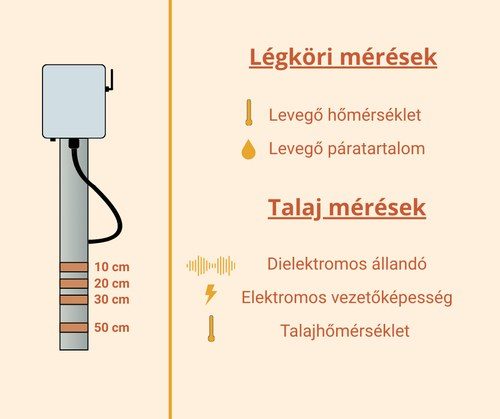
The sensor unit consists of measurement and communication modules; multiple measurement modules can connect to one communication unit. Optional extensions include soil CO₂, redox potential and light sensing. The redox sensor is a separate unit intended for approximately 10% of the production batch.
| Level | Measured parameters |
|---|---|
| Above-ground head | data transmission, LoRaWAN, GPS, air temperature, humidity |
| 10 cm | temperature, electrical conductivity, dielectric permittivity |
| 20 cm | temperature, electrical conductivity, dielectric permittivity |
| 30 cm | temperature, electrical conductivity, dielectric permittivity |
| 50 cm | temperature, electrical conductivity, dielectric permittivity |
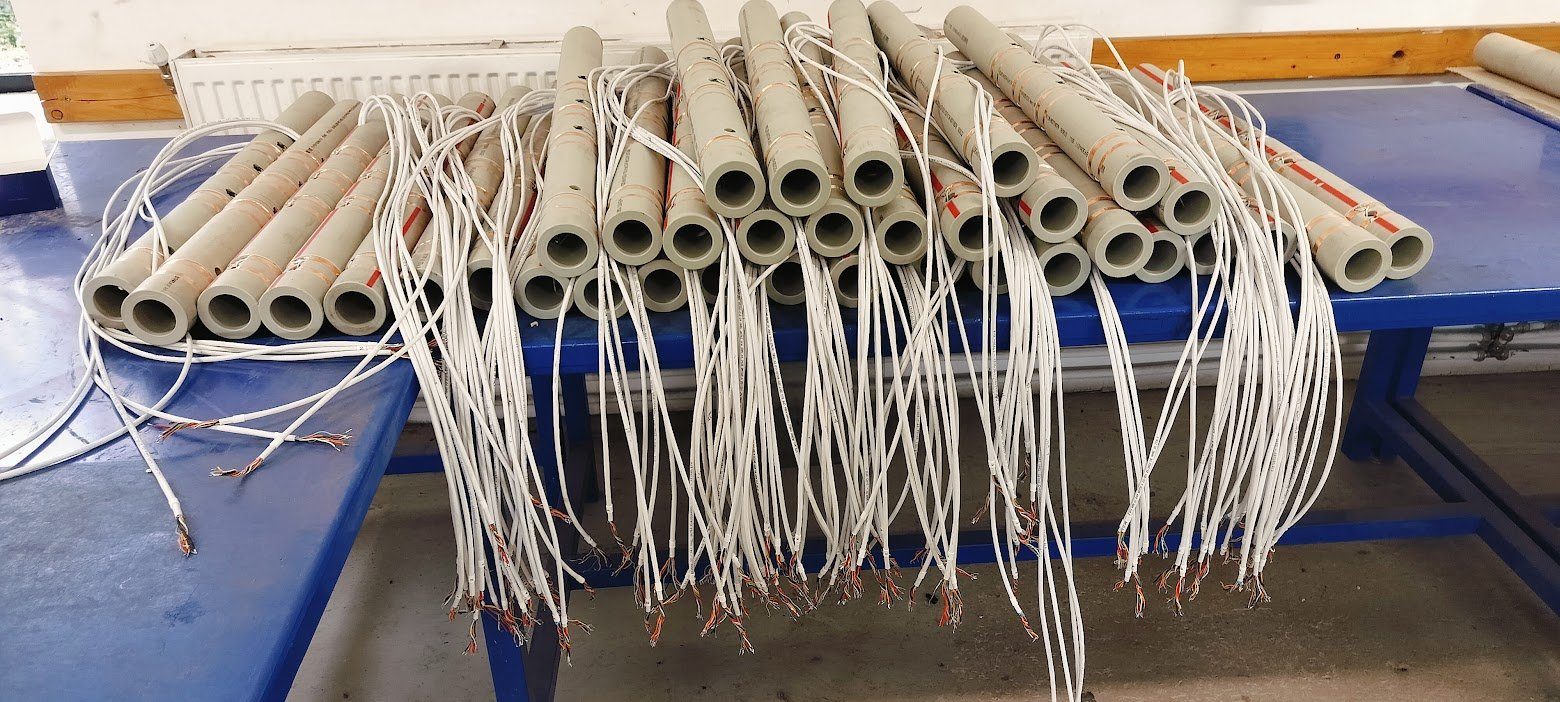
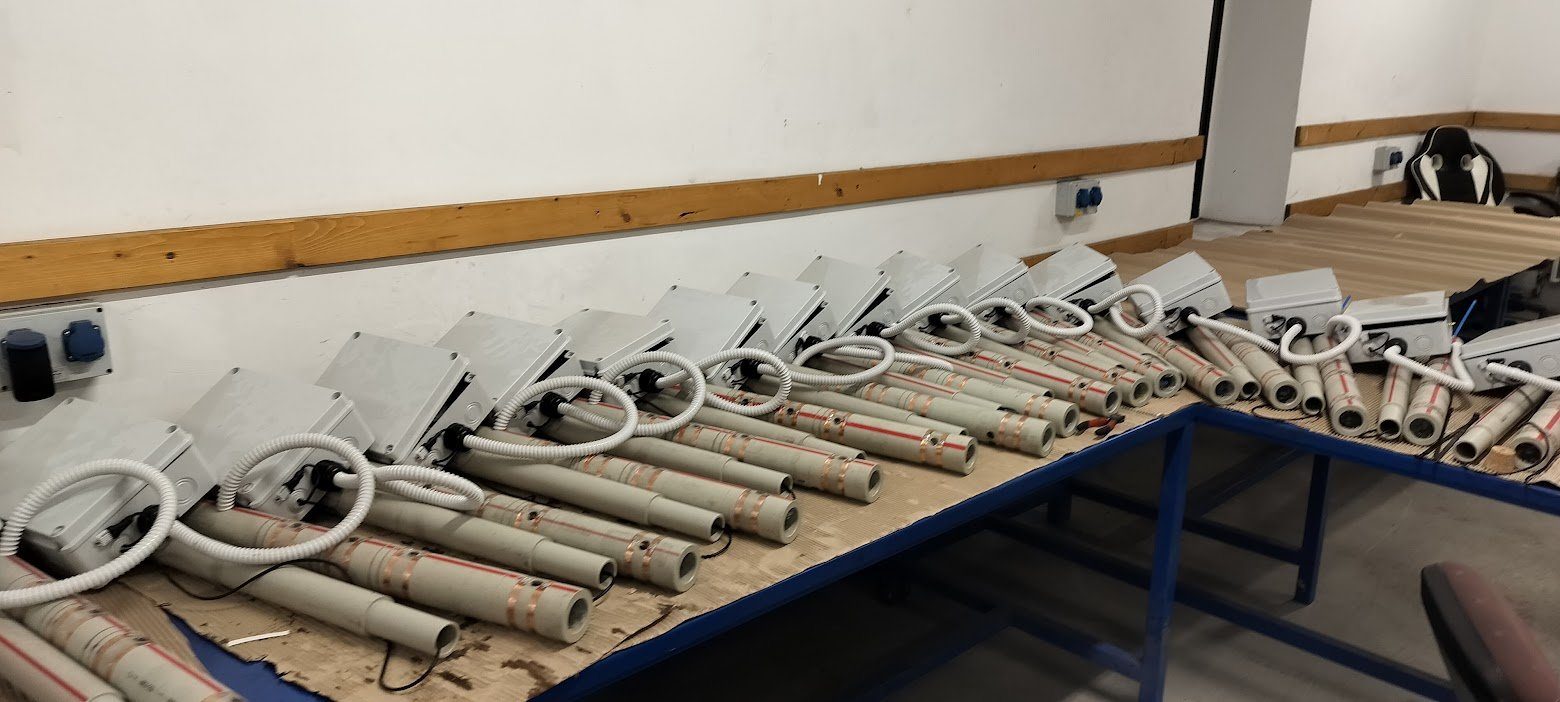
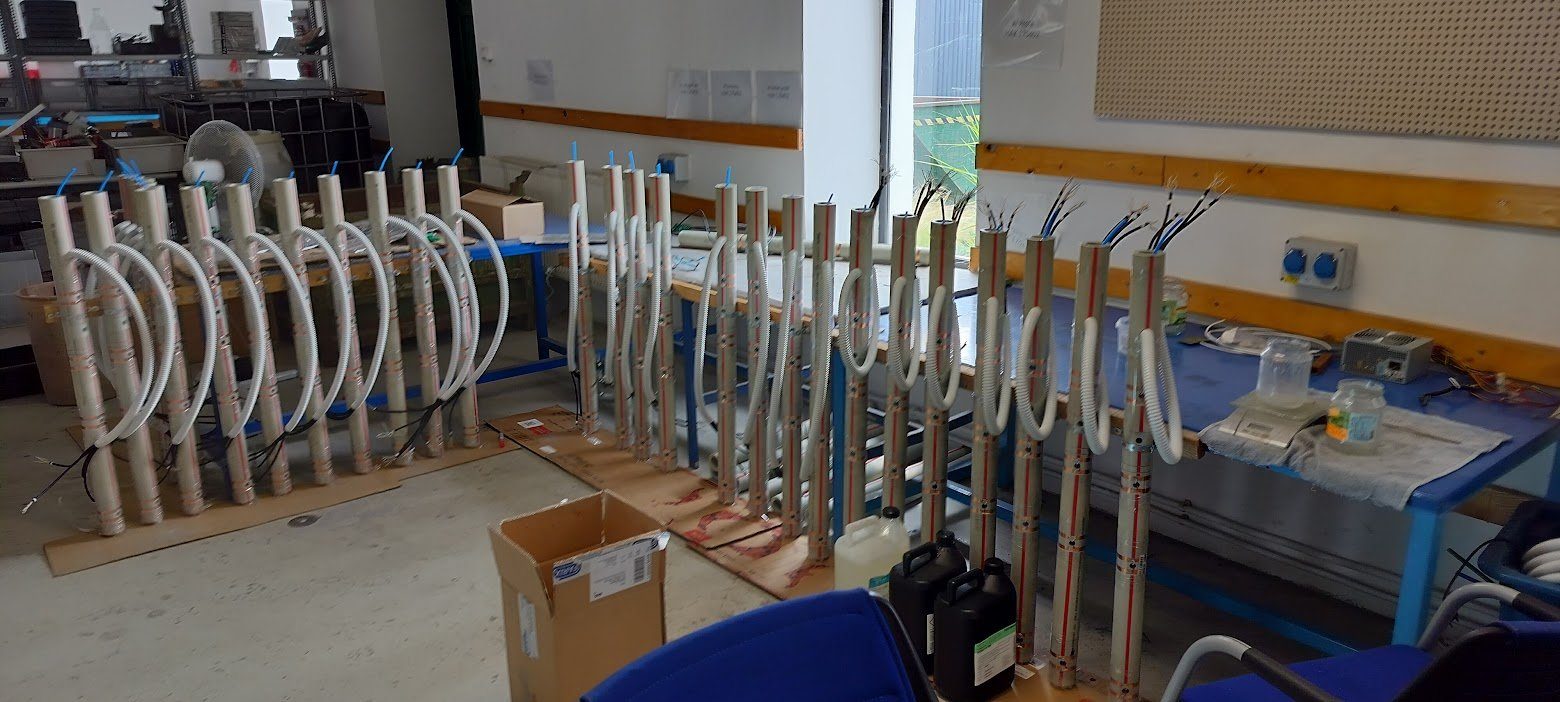
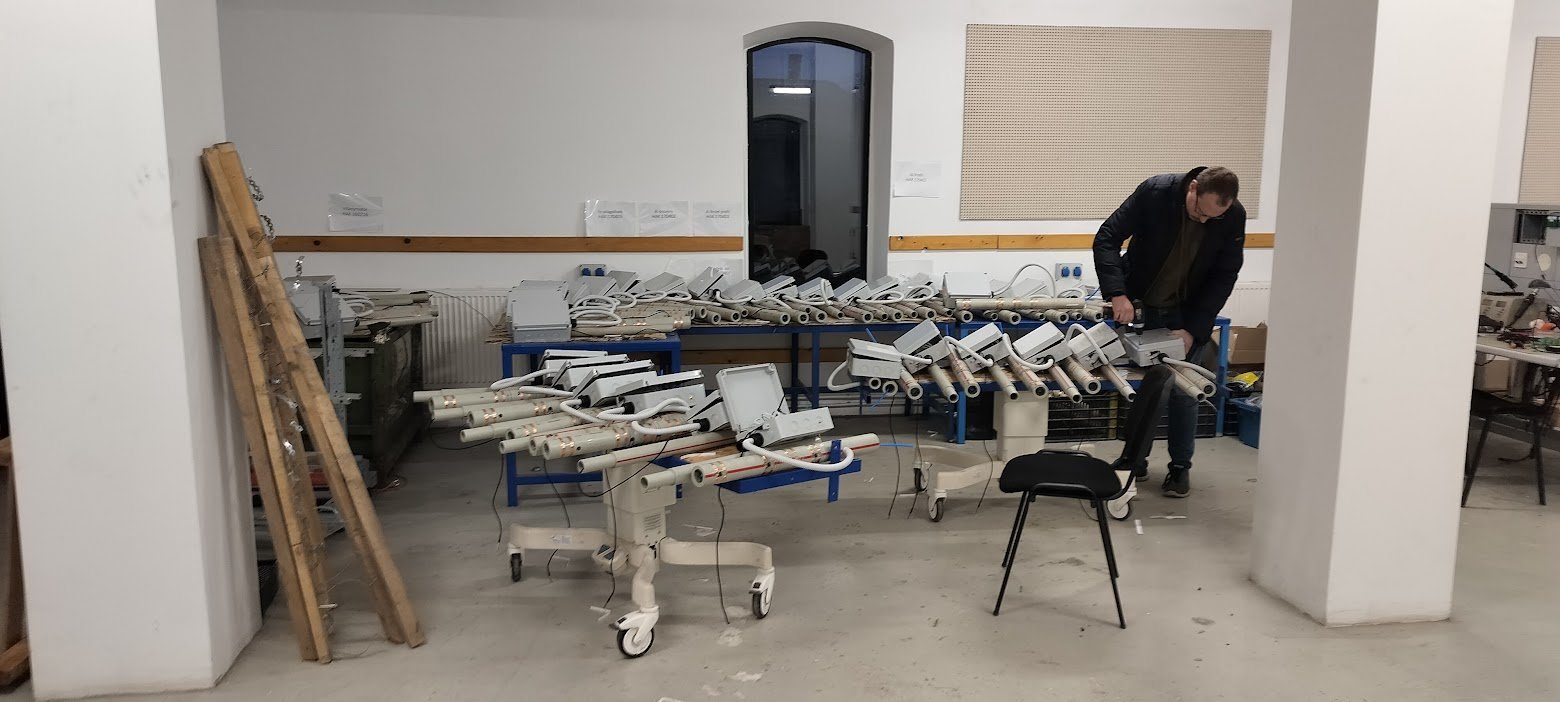
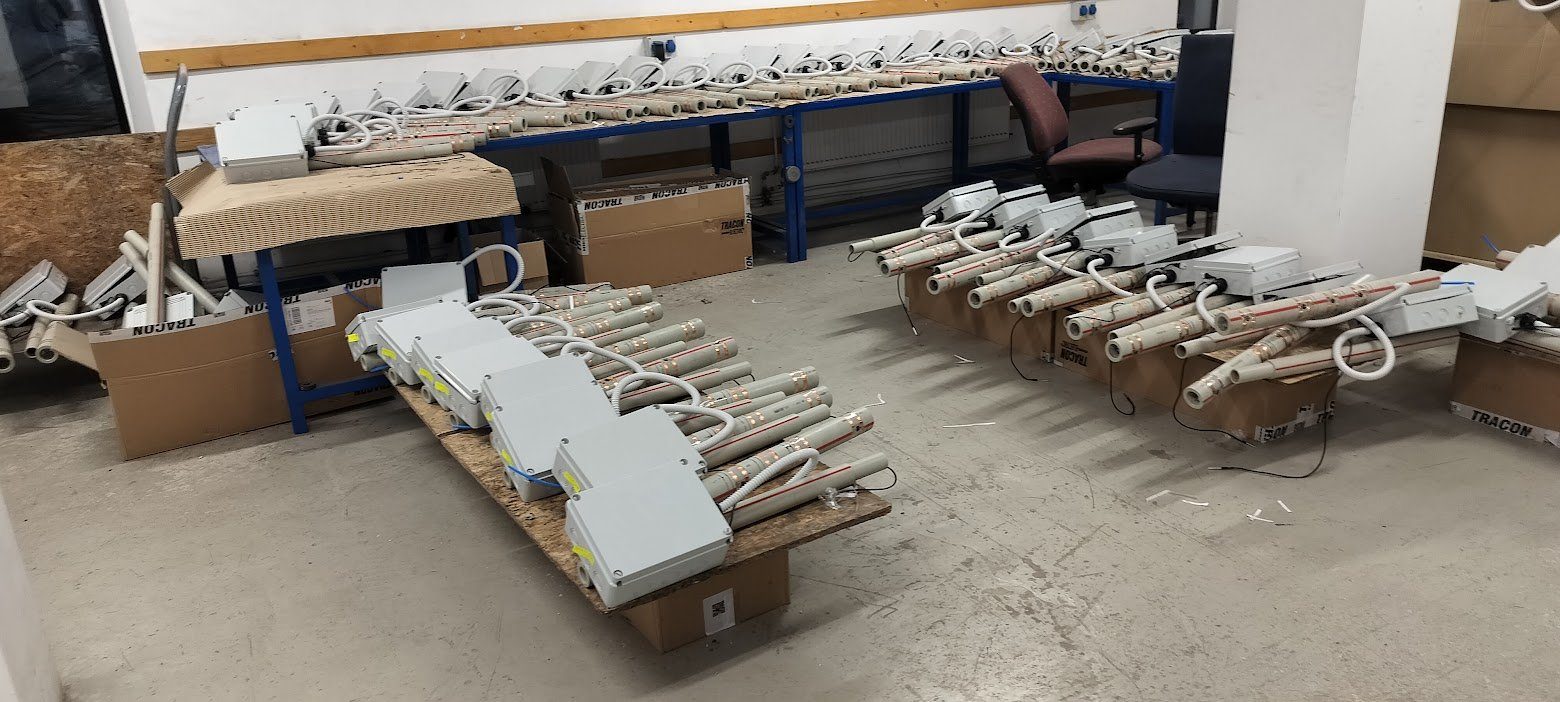
Batch production at the Glia workshop
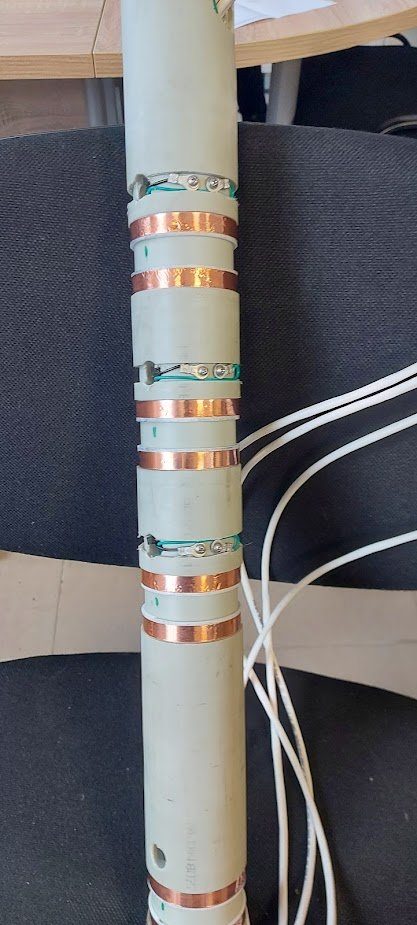
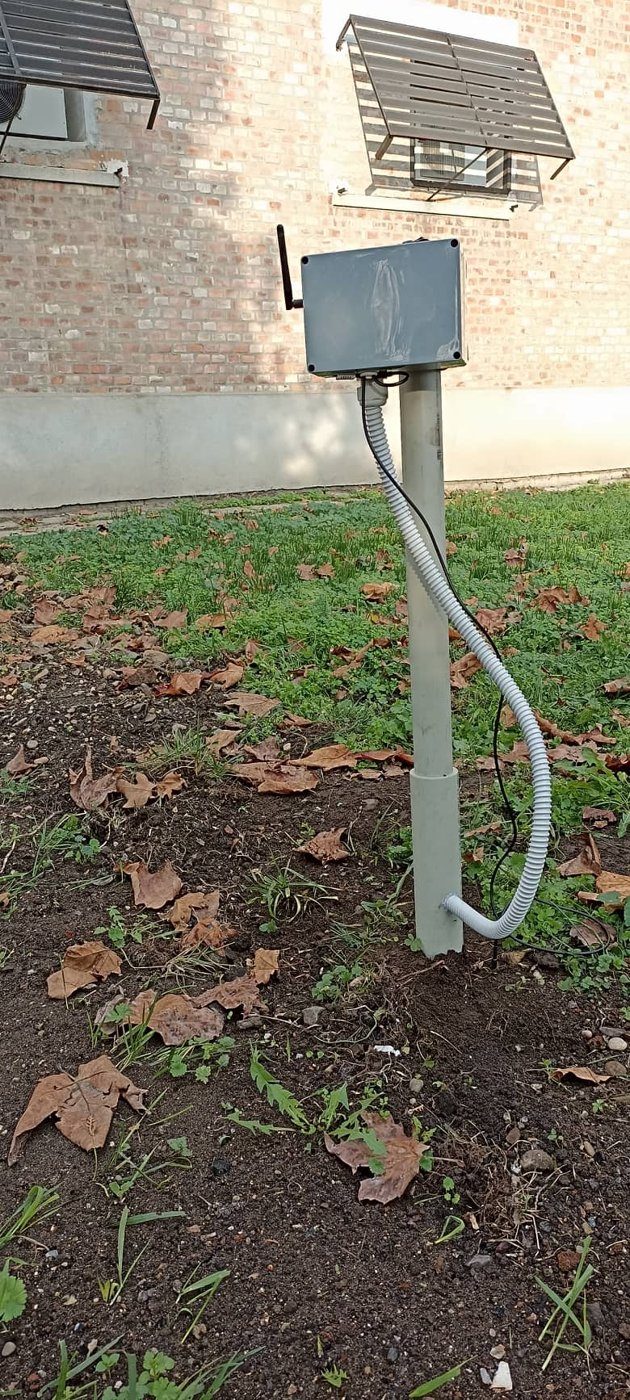
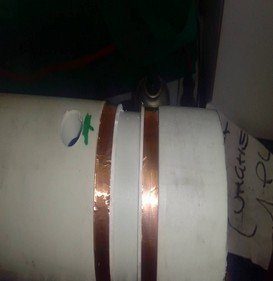
Copper ring electrode pairs are fitted to a plastic tube at each measurement level. Signal wires run inside the tube to the electronics enclosure in the head.
Lessons from the prototypes
Recessed copper strip electrodes
A thick-walled plastic tube carries external copper sensing strips recessed into grooves to avoid loss of sensitivity through the tube wall. Silicone protects the grooves.
Three sensing principles per depth
Dielectric permittivity is measured with copper strips surrounding the tube; conductivity with stainless-steel screws that do not obstruct insertion; and temperature with a stainless-steel-sheathed sensor.
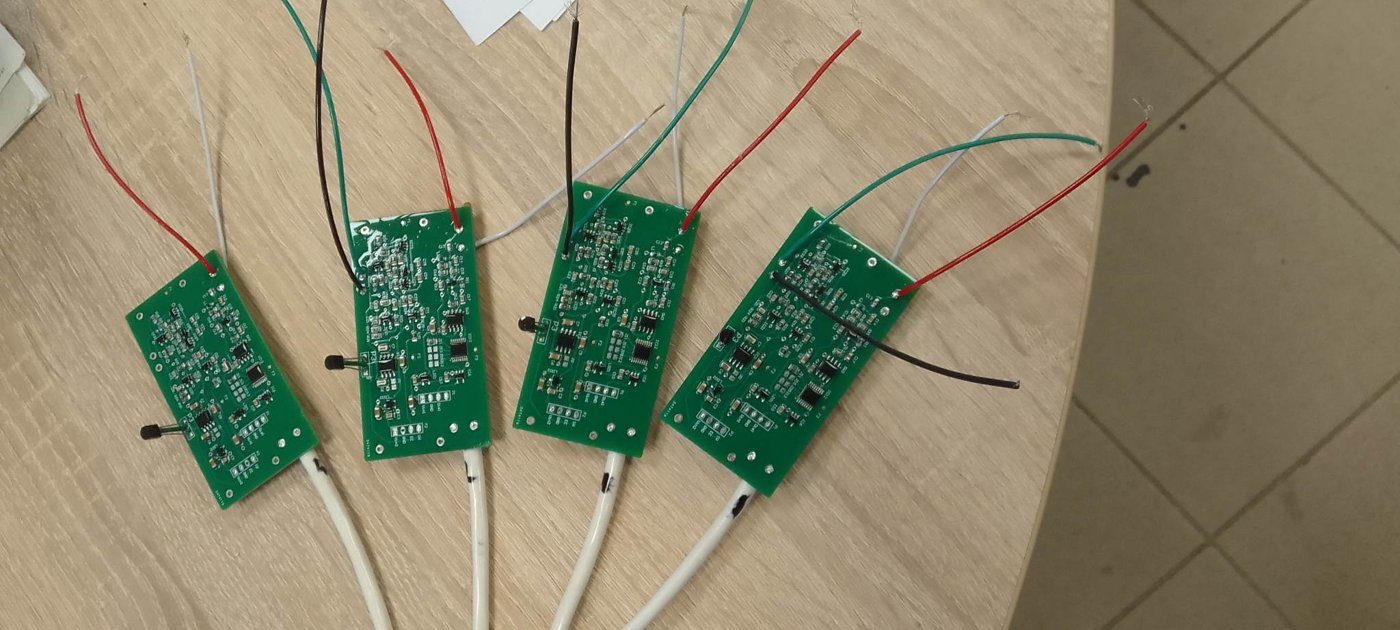
Dedicated boards and soldered connections
Each depth has its own circuit board and cable. Soldered joints replace terminal blocks, and the boards have a protective conformal coating. The tube is filled with two-component silicone rubber cured in an in-house oven.
Modular and continuously tested
The underground probe and communication head can be separated during installation. Sensors are tested throughout assembly; one of the first 30 boards required repair.
Insertion, commissioning and calibration
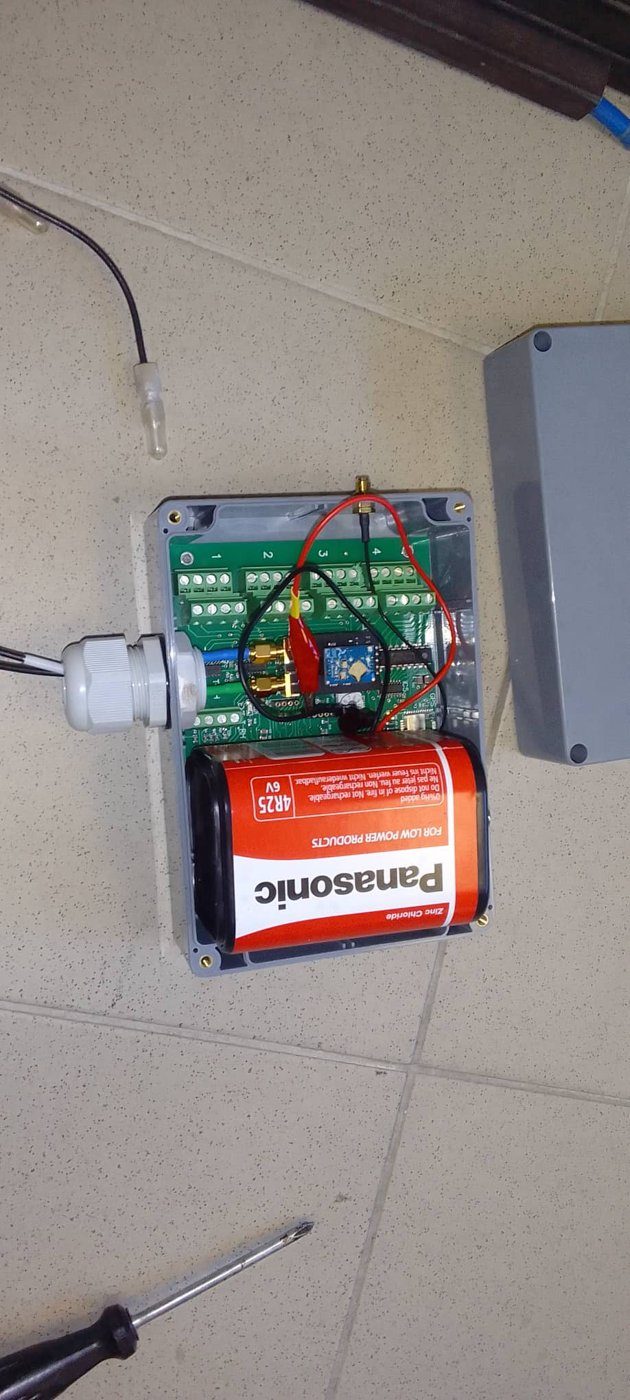
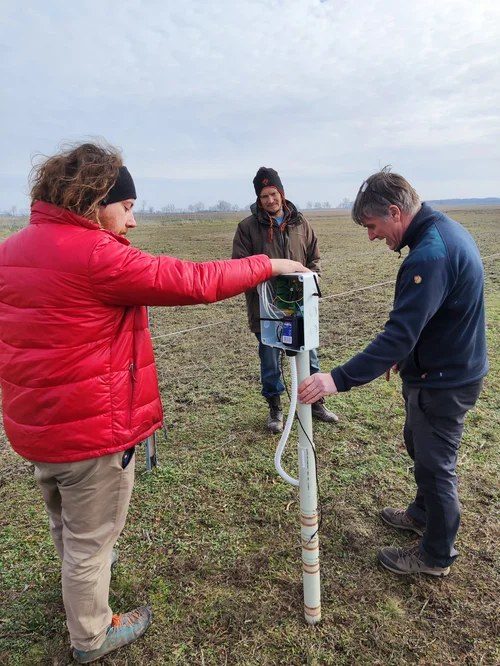
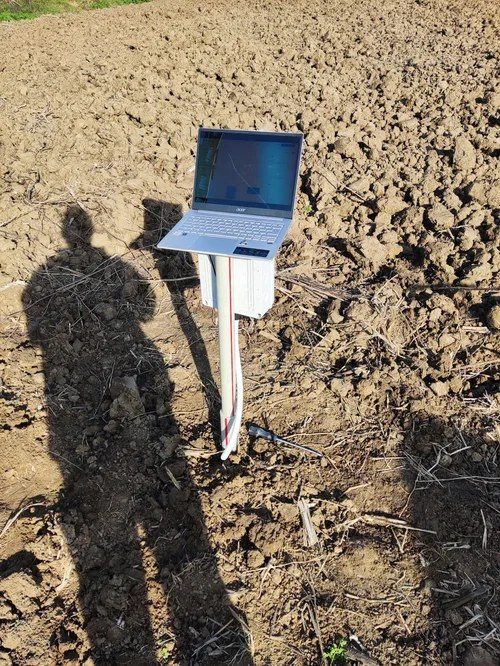
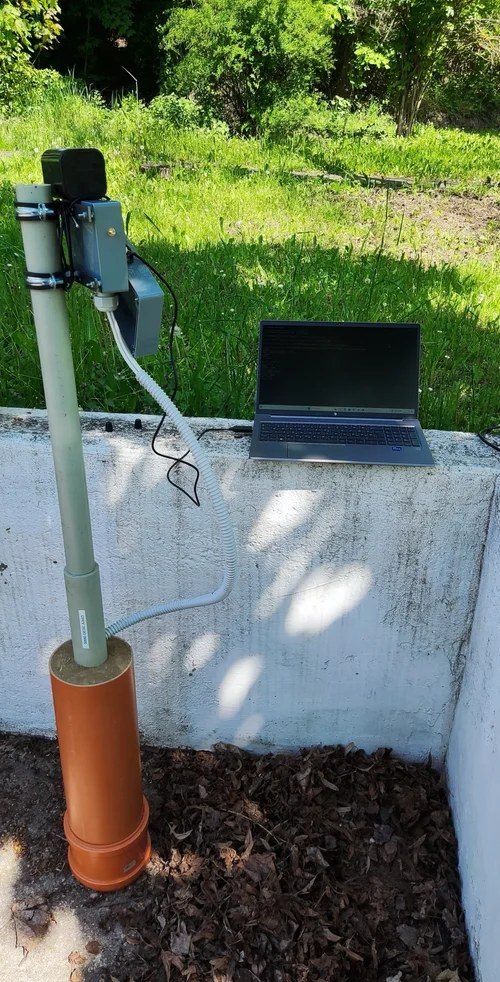
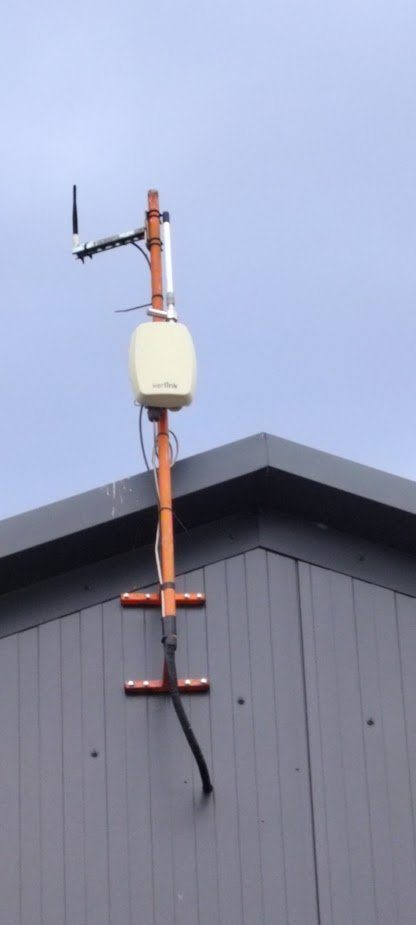
Probes are inserted into the soil, with the head mounted on a mast or directly on the tube. Commissioning and verification of the first data transmission are carried out on site using a laptop.
Self-calibrating FDR sensor
A self-calibration system is integrated into a low-cost FDR soil moisture sensor. Although it does not achieve TDR-level accuracy, it is designed to reduce sensitivity to temperature, soil composition and elapsed time since calibration.
| TDR | FDR | Self-calibrating FDR (Glia) | |
|---|---|---|---|
| Accuracy | high; less sensitive to environmental effects | lower; requires regular calibration | below TDR, but more stable than standard FDR |
| Component cost | expensive high-speed circuitry | low | low; only a few additional components |
| Deployment scale | limited | high; better spatial coverage (Pandey, 2019) | high |
| Post-processing | limited | substantial | significantly reduced |
Self-calibration is a short automatic procedure performed by the sensor controller, which processes calibration values together with measurements. Preliminary studies suggest that it can largely be implemented in software, enabling cost-effective large-scale deployment.
From soil to irrigation machinery
Low-power LoRaWAN communication and a battery with a small solar panel enable months of operation without external power. RTK-enhanced GPS provides georeferenced measurements. GSM connectivity is envisaged where LoRaWAN is unavailable, particularly in urban settings.
Currently in pilot testing Planned closed-loop architecture:
- Sensorssoil and weather measurements transmitted to a local node
- Nodedata collector and agrometeorological station uploading to the cloud
- Processingreal-time cloud processing and database
- Interfacemobile application and PC
- Controlcontrols or recommends settings for VRI irrigation via the nodes
Reinforcement learning (RL)
An out-of-the-box controller designed to adapt continuously to site conditions, keeping soil moisture within specified limits while minimizing operating costs.
Biomass and canopy cover
Satellite, drone or VRI-mounted RGB/infrared/FLIR cameras can provide vegetation indices and canopy cover. Agrometeorological inputs include wind, air pressure, precipitation and UV.
Frost alerts and return on investment
Additional services may include frost-damage alerts. Monitoring the electricity and water consumption of VRI equipment can help evaluate return on investment. SmartDew integration is a future option.
Three sensor configurations
As specified in the National Laboratory project proposal.
| 1. Field crops, tall canopy | 2. Field crops, low canopy | 3. Urban environment | |
|---|---|---|---|
| Connectivity | LoRaWAN + GPS | LoRaWAN + GPS | GSM + GPS |
| In soil | soil moisture at 4 depths; redox and conductivity at one depth each | same as configuration 1 | – |
| At ground level | humidity, temperature, soil CO₂ | same as configuration 1 | – |
| In crop canopy / air | temperature and humidity at 3 heights; CO₂ and particulate matter (2–10 µm) | temperature and humidity at 2 heights; CO₂ and particulate matter (2–10 µm) | temperature, solar irradiance, humidity, particulate matter, CO, CO₂, NOx |
As hardware and as a service
Primarily intended for intensively cultivated irrigated land. Target export markets: Poland, Germany and France.
Developed by Glia Ltd., researchers at the University of Miskolc and precision agriculture specialists, in collaboration with growers and advisers.
- Primary: innovation-oriented farmers managing larger areas
- Secondary: smaller and older farming operations, offered as a service including installation and data interpretation
- Crops: high irrigation demand crops, including perennial legumes, sugar beet, sorghum and long-season maize
ROOTSS, Tiszaszentimre
Glia sensors operate at a regenerative agriculture demonstration site run by Agri Kulti and the Hungarian Soil Science Society under the REINFORCING programme. The sensors for the Tiszaszentimre monitoring network were supplied by Tarnabod 2.0 – Jövőgyár, which also supported hardware and software operation.
The project has published sensor readings regularly since summer 2025. In August, reported measurements included 60 °C in soil and 40 °C at the surface. A sensor demonstration was held at the Regenerative Agriculture Professional Day on 5 September 2025. ROOTSS reports that these data can help optimize irrigation, fertilization and crop protection.
Glia Kft.
For pilot installations, research collaborations or service enquiries.